bmi age chartbmi weight calculatorbmi for agebmi calculation formulaideal weightbmi by agebmi standard calculator
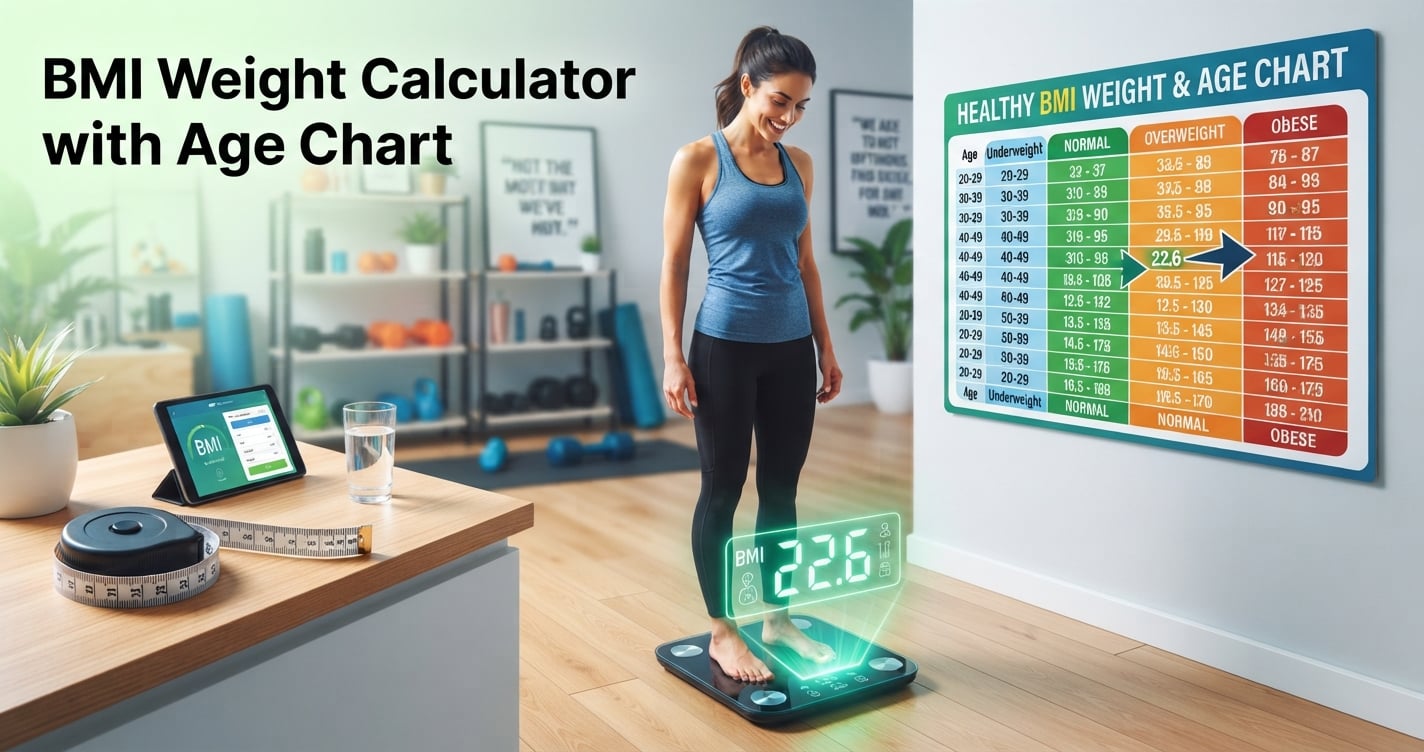
You want to know if you’re eating the right number of calories or if your current weight is actually healthy. It’s a question that pops up constantly. The easiest, fastest way to get an answer? A bmi weight calculator.
It’s not a magic pill. It’s more like a compass. In seconds, you input your height, weight, and age. The tool spits out a WHO-approved classification, a suggested healthy weight range, and a personalized ideal weight goal. No sign-ups. No waiting. Just data.
This guide breaks down how it works, why age changes the math, and why this specific tool beats the cluttered alternatives you’re probably seeing in your search results.
What is the BMI Calculator?
Let’s strip away the jargon. A BMI calculator is a web tool that calculates your Body Mass Index. It’s a number derived from two things: how heavy you are and how tall you are.
Here’s the kicker: this tool runs entirely in your browser. Your data doesn’t leave your device. There is no server storing your health info. No marketing lists. It supports both metric (kilograms/centimeters) and imperial (pounds/feet/inches) units. It displays the WHO classification instantly and provides a bmi age chart so you can see how your numbers stack up against your life stage.
Why Bother with BMI?
- Quick health snapshot: It tells you if you’re underweight, normal, overweight, or obese. Fast.
- Goal setting: It pairs with the ideal weight range so you can set realistic targets rather than guessing.
- Standardization: Doctors use it. Researchers use it. It’s a shared language for comparing health data across populations.
How to Calculate BMI Using Weight, Height, and Age
Step-by-Step Calculation
| Step | Action | Detail |
|---|---|---|
| 1 | Gather measurements | Get your weight (kg or lbs) and height (cm or ft-in). |
| 2 | Enter age | Age handles the bmi for age interpretation. |
| 3 | Select unit system | Toggle between metric and imperial. |
| 4 | Compute | Hit Calculate. See your BMI, WHO category, and healthy weight range. |
Using the Tool
Forget manual math. Use the BMI Calculator tool, fill in the boxes, and let the script handle the heavy lifting. The result page includes a bmi age chart that places your score within age-specific percentiles. It’s that simple.
BMI Weight Calculator – Instant Online Tool
Input Fields Explained
| Field | What to Enter | Units | Tips |
|---|---|---|---|
| Height | Your stature | cm / ft in | Use a wall-mounted tape for accuracy. |
| Weight | Your body mass | kg / lbs | Weigh yourself after waking, before breakfast. |
| Age | Your current age | years | Needed for bmi by age interpretation. |
Interpreting the Results
- BMI value: The raw number (e.g., 23.4).
- WHO classification: Underweight, Normal, Overweight, or Obese (Class I-III).
- Healthy weight range: The specific weight interval that fits your height.
- Age-adjusted insights: The bmi age chart shows how typical BMI values shift as you get older.
Understanding BMI Age Charts
How Age Affects BMI Interpretation
The bmi calculation formula itself? It doesn’t change. But your body does.
Younger adults usually carry more muscle. Older adults often lose muscle and gain fat. This means a BMI of 26 might mean completely different things for a 25-year-old athlete versus a 65-year-old retiree. Context matters.
Comparing BMI by Age Groups
| Age Group | Typical BMI Range (Healthy) | Common Considerations |
|---|---|---|
| 18‑25 | 18.5 – 24.9 | Higher metabolism, more muscle. |
| 26‑45 | 18.5 – 24.9 | Lifestyle changes often impact weight here. |
| 46‑65 | 20 – 26 | Slightly higher range accepted due to natural body-fat increase. |
| 65+ | 22 – 27 | Focus on functional health; BMI becomes less predictive. |
BMI Computation Formula Explained
The Standard BMI Formula
- Metric:
BMI = weight (kg) / (height (m))² - Imperial:
BMI = (weight (lbs) * 703) / (height (inches))²
These equations are hard-coded into the bmi standard calculator on SmartToolverse. You get consistent, reliable results every single time.
Adjustments for Age and Body Composition
- Age factor: Not a mathematical tweak, but the bmi for age chart provides the necessary context.
- Body composition: Athletes with high muscle mass often register a higher BMI. If you’re one of them, consider pairing BMI with a BMR Calculator to get the full picture.
Ideal Weight vs BMI – Common Questions
How to Find Your Ideal Weight
The tool calculates a healthy weight range based on your height and the WHO normal BMI band (18.5 – 24.9). For example, if you are 170 cm tall, your ideal weight range is roughly 53 kg – 72 kg (116 lb – 159 lb).
When BMI May Not Reflect Health
BMI has blind spots.
- Athletes & bodybuilders: High muscle leads to elevated BMI but low body fat.
- Elderly: Loss of muscle mass can hide excess fat.
- Pregnancy: BMI simply isn’t applicable during gestation.
In these cases, don’t rely on BMI alone. Supplement it with waist-to-hip ratio, body-fat percentage, or a BMR Calculator.
Feature & Accuracy Comparison
| Feature | SmartToolverse BMI Calculator | Competitor A | Competitor B |
|---|---|---|---|
| Unit Flexibility | Metric & Imperial toggle | Metric-only | Separate converters |
| WHO Classification | Visible label (Underweight, Normal, etc.) | Raw number only | Raw number only |
| Ideal Weight Guidance | Shows healthy range & ideal weight | None | None |
| Privacy | 100 % local computation, no data storage | Stores data for marketing | Stores data |
| Age-Adjusted Chart | Integrated bmi age chart | Not available | Not available |
Why Choose This Free Online Tool
- Instant results: No page reloads. Calculations happen in milliseconds.
- Zero tracking: All data stays on your device. Complete privacy.
- No sign-up required: One-click access to a free bmi weight calculator.
- Cross-device ready: Works on desktops, tablets, and smartphones.
Ready to see where you stand? Try the free bmi weight calculator now. It’s the first step toward understanding your metrics.
Related Online Tools
Explore these complementary browser utilities to streamline your everyday calculations:
- BMR Calculator: Free online browser utility on SmartToolverse.
- Age Calculator: Free online browser utility on SmartToolverse.
- Word Counter: Free online browser utility on SmartToolverse.
Frequently Asked Questions
Can BMI be used for children?
Not the same way. BMI for children is interpreted using percentile charts that compare a child’s BMI to peers of the same age and sex. The standard adult bmi calculation formula doesn’t apply directly. You need a pediatric BMI-for-age chart for accurate assessment.
Why does BMI change with age?
Because your body changes. Muscle mass typically declines while fat mass rises as you age. The mathematical formula stays constant, but the health implications shift. That’s why the bmi age chart provides age-specific guidance instead of a one-size-fits-all number.
What’s the difference between BMI calculators?
Most are clones. The real differences lie in unit support, privacy handling, and additional features. Do they show WHO classifications? Do they offer an ideal weight range? Do they include age-adjusted charts? SmartToolverse’s calculator covers all these bases while keeping your data private.
How accurate is BMI for athletes and bodybuilders?
It’s often misleading. BMI doesn’t differentiate between muscle and fat. Athletes with high lean mass may be classified as “Overweight” or “Obese” despite having very low body fat. Always pair BMI with a BMR Calculator or body-fat measurement for a more accurate health assessment.
How can I improve a high BMI reading?
Focus on consistency. Adopt a balanced diet rich in whole foods. Incorporate regular aerobic and strength-training exercises. Monitor your progress using the BMI tool alongside a BMR Calculator to track your caloric needs effectively.
Understanding your bmi weight calculator results—and how they relate to age, ideal weight, and overall health—puts you in control. You stop guessing. You start acting. With instant, private, and fully featured calculations, SmartToolverse’s free bmi weight calculator is a straightforward resource for anyone serious about tracking their wellness.
Explore more health-focused utilities at SmartToolverse.
Try Our Smart Tools
Put what you've learned into practice with our suite of AI-enhanced tools and smart calculators.