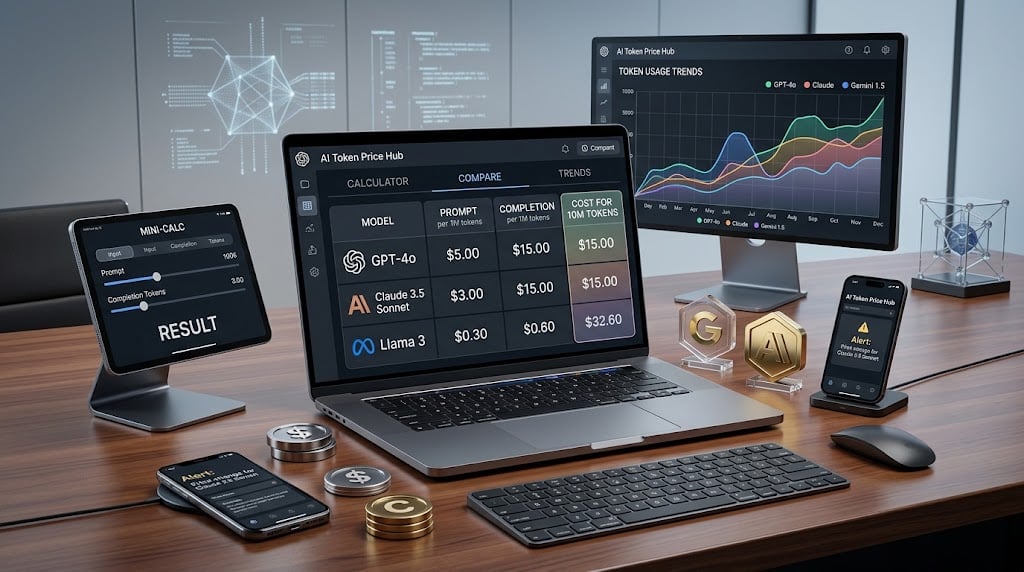
Short answer: a token is a small chunk of text, often a whole short word or part of a longer one, that a language model reads and writes. In English, one token is about 4 characters or three-quarters of a word, so 1,000 words is roughly 1,300 tokens. AI APIs charge per million tokens, with separate prices for input, output and cached input. Paste a prompt into our free token cost calculator to see its exact token count and cost per model.
What a token is
Language models do not see letters or words. Before your text reaches the model, a tokenizer splits it into pieces from a fixed vocabulary of common chunks. Frequent words are usually one token; rare words, names, numbers and code get split into several.
| Text | Split by OpenAI's o200k_base tokenizer | Tokens |
|---|---|---|
| cat | cat | 1 |
| tokenization | token + ization | 2 |
| 2026-11-17 | 202 + 6 + - + 11 + - + 17 | 6 |
Exact splits depend on the model, because each company trains its own tokenizer. The same paragraph can be a different number of tokens on OpenAI, Claude and Gemini models.
Tokens to words: the rules of thumb
OpenAI's guide to what tokens are and how to count them gives these estimates for English text:
- 1 token ≈ 4 characters
- 1 token ≈ ¾ of a word
- 100 tokens ≈ 75 words
Turned around, that gives handy conversions:
| Amount of text | Approximate tokens |
|---|---|
| One short sentence (15 words) | 20 |
| One page (500 words) | 670 |
| A 2,000-word article | 2,700 |
| 750,000 words (about 10 novels) | 1,000,000 |
These ratios are for English. Many other languages, as well as code and text full of numbers, use more tokens per word, sometimes much more. For a real count, run the actual text through a tokenizer.
So how much is a million tokens? About 750,000 English words, or around 1,500 pages of plain text. In cost terms, it is exactly the unit providers quote: "$2 per million input tokens" means 1,000,000 tokens of prompt cost $2.
Input, output and cached tokens
Every API call has two sides, and they are priced differently:
- Input tokens: everything you send. The system prompt, the conversation so far, any documents or tool definitions, and the user's message.
- Output tokens: everything the model writes back. These cost more, usually 4 to 8 times the input price, because generating text takes more computing work than reading it. For reasoning models, the hidden "thinking" tokens are generally billed as output too.
- Cached input tokens: input the provider has seen recently and stored, such as a long system prompt you send with every request. Cache hits are billed at a fraction of the normal input price.
Caching has small print. Anthropic, for example, charges 1.25 times the normal input price to write to its 5-minute cache and about 0.1 times to read from it, according to its pricing page. So caching pays off only for text you reuse several times within the cache window.
A few example rates, to show the structure (not a full or current price list):
| Example model | Input / 1M | Cached input / 1M | Output / 1M |
|---|---|---|---|
| OpenAI gpt-5-nano | $0.05 | $0.005 | $0.40 |
| Claude Sonnet 5.5 | $2.00 | $0.10 | $10.00 |
| OpenAI gpt-6-astra | $10.00 | $1.00 | $50.00 |
Example rates from the OpenAI API pricing page and Anthropic pricing page, standard tier, checked 17 November 2026. Prices change often; always check the provider's page before you budget.
The cost formula, with a worked example
For one request:
cost = (uncached input tokens × input price
      + cached input tokens  × cached price
      + output tokens        × output price) ÷ 1,000,000
Worked example: a support chatbot sends a 1,200-token system prompt plus 300 tokens of user message and history (1,500 input tokens), and gets a 300-token reply. Using the Claude Sonnet 5.5 example rates above:
- Without caching: (1,500 × $2 + 300 × $10) ÷ 1,000,000 = $0.006 per request
- With the system prompt cached: (300 × $2 + 1,200 × $0.10 + 300 × $10) ÷ 1,000,000 = $0.00372 per request
Notice where the money goes: the 300 output tokens cost as much as all 1,500 input tokens. That pattern is common, which is why output length is the first thing to look at. Our LLM token cost calculator does this sum for you: it counts your prompt's tokens in the browser with OpenAI's o200k_base tokenizer (an estimate for Claude, Gemini and DeepSeek, which use their own), and lets you set output length, cache share and batch mode.
How to estimate a monthly bill
- Measure the average input and output tokens per request from real logs or a few test runs. Do not guess from word counts if you can count.
- Multiply by requests per month. 100,000 requests at $0.006 is $600 a month; with caching, $372.
- Remember that chat history grows. In a 10-turn conversation, every turn resends all earlier turns as input, so later turns cost more than the first.
- Add a buffer of 20 to 30% for retries, long outliers and prompt changes.
Model choice changes the total far more than anything else. The same 100,000 requests (150 million input tokens, 30 million output tokens) cost about $19.50 at the gpt-5-nano example rates and about $3,000 at the gpt-6-astra example rates.
Ways to cut LLM token cost
- Use a smaller model where it is good enough. Classification, extraction and short rewrites rarely need a flagship model. Test the small one first.
- Cache what repeats. Put the fixed parts (system prompt, instructions, reference documents) at the start of the prompt so they can be cached, and the changing part at the end.
- Batch what can wait. OpenAI and Anthropic both offer a Batch API at 50% off input and output for jobs that do not need an instant answer, such as overnight summaries.
- Shorten prompts. Remove repeated instructions, long examples you no longer need and verbose formatting rules. Every token in a system prompt is paid on every call.
- Cap and shape the output. Set a maximum output length and ask for compact formats (a short JSON object, not an essay) when a person will not read the reply.
- Trim conversation history. Summarize old turns or keep only the last few instead of resending the whole chat.
If you are counting tokens for a document rather than a prompt, our Word Counter gives word and character counts you can convert with the rules of thumb above.
FAQ
What is a token in AI?
A token is the unit of text a language model processes: a short word, part of a word, a number chunk or a punctuation mark. In English, one token averages about 4 characters.
How much is a million tokens?
Roughly 750,000 English words, or about 1,500 pages of plain text. Its price is whatever the provider lists "per 1M tokens" for that model, separately for input and output.
Why are output tokens more expensive than input tokens?
The model generates output one token at a time, which takes more computing work than reading the input in one pass. Providers price that difference into the output rate.
What is the cost per LLM token?
Divide the per-million price by 1,000,000. At $2 per million input tokens, one token costs $0.000002. That is why costs are almost always discussed per million.
Do spaces and punctuation count as tokens?
Yes. Spaces are usually merged into the following word's token, while punctuation, line breaks and symbols are often tokens of their own.
To get exact numbers for your own prompt, paste it into the free AI token cost tool: it shows the token count, the cost per call and a monthly estimate across several providers side by side.