Short answer: to calculate a weighted GPA, add a bonus to each harder class's grade points (most often +0.5 for Honors and +1.0 for AP or IB), multiply each result by the class's credits, add them up and divide by your total credits. An F stays at 0 whatever the level. You can do it by hand with the steps below, or enter your classes in our free weighted GPA calculator and pick a level for each one.
This guide assumes you know the basic grade-points-times-credits method. If not, start with our step-by-step guide to the 4.0 GPA formula, then come back for the weighting.
The weighted GPA scale: what each grade is worth
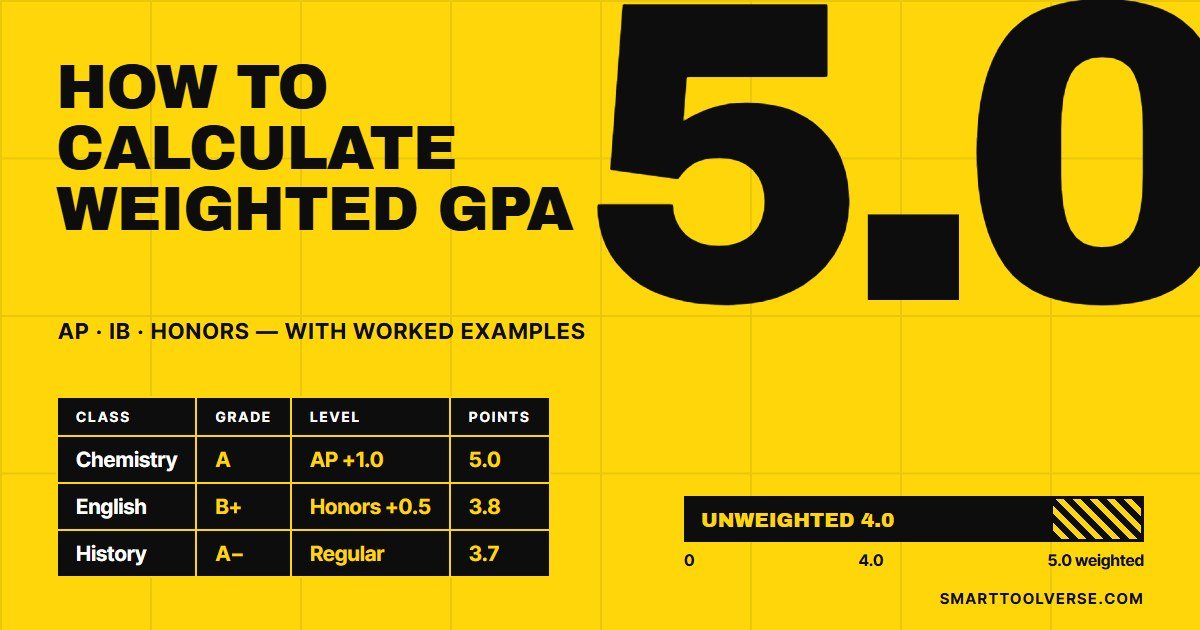
On the most common system, the bonus sits on top of the normal 4.0 points. That makes an A in an AP class worth 5.0, which is why weighted GPAs are often described as being "on a 5.0 scale".
| Grade | Regular | Honors (+0.5) | AP / IB (+1.0) |
|---|---|---|---|
| A | 4.0 | 4.5 | 5.0 |
| A− | 3.7 | 4.2 | 4.7 |
| B+ | 3.3 | 3.8 | 4.3 |
| B | 3.0 | 3.5 | 4.0 |
| C | 2.0 | 2.5 | 3.0 |
| D | 1.0 | 1.5 | 2.0 |
| F | 0.0 | 0.0 | 0.0 |
Notice the useful pattern: a B in an AP class (4.0) counts the same as an A in a regular class (4.0) on this scale.
Weighting systems schools actually use
There is no national standard. Your school's handbook or transcript legend is the only reliable source. These are the patterns you will meet most often:
| Policy type | Honors bonus | AP / IB bonus | Top weighted GPA |
|---|---|---|---|
| Split weighting (most common) | +0.5 | +1.0 | 5.0 |
| Flat weighting | +1.0 | +1.0 | 5.0 |
| AP/IB only | +0 | +1.0 | 5.0 |
| Passing-grade rule | +0.5 or +1.0, only for a C or better | Same rule | 5.0 |
| Unweighted only | +0 | +0 | 4.0 |
| Other scales | Varies | Varies | Some districts use 4.5, 6.0 or 100-point scales |
Dual-enrollment (college) classes are often weighted like AP, and some schools cap how many weighted classes count. If your school uses a policy that is not on this list, the method below still works: just swap in its bonus values.
How to calculate weighted GPA, step by step
- List every class with its letter grade, its level (regular, Honors, AP, IB, dual enrollment) and its credits. A full-year high school class is usually 1 credit; a semester class is often 0.5.
- Turn each letter grade into normal 4.0 grade points (A = 4.0, B+ = 3.3 and so on).
- Add the level bonus to each class that earned a passing grade. Leave an F at 0.
- Multiply each weighted value by the class's credits. These are your weighted quality points.
- Add up the weighted quality points and divide by the total credits.
weighted GPA = Σ (grade points + level bonus) × credits ÷ Σ creditsTwo things people get wrong: dividing by the number of classes when credits differ, and adding the bonus to an F. Both push the result too high.
Worked example 1: one semester, all 1-credit classes
| Class | Level | Grade | Unweighted | Weighted |
|---|---|---|---|---|
| English 10 | Honors | A | 4.0 | 4.5 |
| US History | AP | B+ | 3.3 | 4.3 |
| Algebra II | Regular | A− | 3.7 | 3.7 |
| Chemistry | Honors | B | 3.0 | 3.5 |
| Spanish III | Regular | A | 4.0 | 4.0 |
| Total (5 credits) | 18.0 | 20.0 |
Unweighted GPA: 18.0 ÷ 5 = 3.60. Weighted GPA: 20.0 ÷ 5 = 4.00. The three advanced classes added 0.5 + 1.0 + 0.5 = 2.0 points, which is 0.40 once it is spread across five credits.
Worked example 2: a mixed transcript under three policies
Now a junior with AP, IB, Honors, regular and half-credit classes. The same grades give a different weighted GPA depending on the school's policy:
| Class | Level | Grade | Credits |
|---|---|---|---|
| AP Biology | AP | A− | 1 |
| IB English HL | IB | B+ | 1 |
| Precalculus | Honors | B | 1 |
| World History | Regular | A | 1 |
| Spanish IV | Honors | A | 1 |
| Health | Regular | A | 0.5 |
| Art | Regular | B+ | 0.5 |
The unweighted quality points are 3.7 + 3.3 + 3.0 + 4.0 + 4.0 + 2.0 + 1.65 = 21.65 over 6 credits, so the unweighted GPA is 3.61. The half-credit classes count half: Health adds 4.0 × 0.5 = 2.0 points.
| Policy | Bonus points added | Weighted quality points | Weighted GPA |
|---|---|---|---|
| Split (+0.5 Honors, +1.0 AP/IB) | 2 × 1.0 + 2 × 0.5 = 3.0 | 24.65 | 4.11 |
| Flat (+1.0 for all three levels) | 4 × 1.0 = 4.0 | 25.65 | 4.28 |
| Unweighted only | 0 | 21.65 | 3.61 |
Same student, same grades, a spread of 0.67 points. That is why comparing weighted GPAs between schools tells you very little.
Worked example 3: what a failed AP class does
| Class | Level | Grade | Unweighted | Weighted |
|---|---|---|---|---|
| Calculus | AP | F | 0.0 | 0.0 (no bonus) |
| Chemistry | AP | B | 3.0 | 4.0 |
| English | Honors | A− | 3.7 | 4.2 |
| US History | Regular | A | 4.0 | 4.0 |
| Physics | Regular | B+ | 3.3 | 3.3 |
| Spanish | Regular | A | 4.0 | 4.0 |
| Total (6 credits) | 18.0 | 19.5 |
Unweighted: 18.0 ÷ 6 = 3.00. Weighted: 19.5 ÷ 6 = 3.25. The AP bonus does not rescue a failing grade.
For comparison, a D in that AP class would be worth 2.0 weighted (1.0 + 1.0) and give a weighted GPA of 3.58, exactly the same as a C in regular Calculus. At a school with a passing-grade rule that only weights a C or better, the AP D stays at 1.0. If you are struggling in an AP class, ask about your school's drop deadline and how a withdrawal (W) shows on the transcript before the grade is final.
How much does an AP class boost your GPA?
The bonus is 1.0 for that one class, but your GPA is an average, so the effect is diluted:
GPA boost = bonus × class credits ÷ total credits- One AP class out of six 1-credit classes: 1.0 × 1 ÷ 6 = +0.17 to the weighted GPA.
- One AP class out of 24 credits by the end of junior year: 1.0 ÷ 24 = about +0.04.
- One Honors class (+0.5) out of six: +0.08.
Take an AP class for the learning and the transcript, not the boost. A drop from A to C in a regular class costs 2.0 points; the AP bonus only adds 1.0.
Weighted vs unweighted GPA
| Unweighted GPA | Weighted GPA | |
|---|---|---|
| Scale | 0–4.0 | Usually 0–5.0 (school-specific) |
| Counts class difficulty? | No | Yes, through the level bonus |
| Straight A's gives | Exactly 4.0 | Between 4.0 and 5.0, depending on your classes |
| Comparable between schools? | Fairly | Poorly, because policies differ |
| Where you see it | College transcripts, most honors lists | High school transcripts, class rank |
Most high schools report both, so always say which one you mean. "3.9" on one form and "4.3" on another may be the same student.
How colleges recalculate your GPA
Many colleges do not take your school's weighted GPA at face value. They rebuild it from your transcript using their own rules, so every applicant is measured the same way. Typical changes:
- Only core academic classes count (English, math, science, social studies, languages); PE, health and electives are dropped.
- Pluses and minuses may be ignored, so a B+ and a B− are both 3.0.
- Their own bonus replaces your school's, or there is no bonus at all and rigor is judged separately.
- Only certain years count, often 10th and 11th grade.
The University of California GPA rules are a well-documented example (as of November 2026). UC counts A–G courses from the summer after 9th grade through the summer after 11th grade, gives A = 4, B = 3, C = 2, D = 1 with no plus or minus, and adds 1 extra point per semester of a UC-recognized honors-level course (AP, IB HL, certain IB SL and college courses, and UC-certified honors classes). A D or F earns no extra point, and the extra points are capped at 8, with no more than 4 from 10th grade. For nonresidents only AP and IB courses get the extra point.
Example: 22 semester grades worth 76 points (unweighted 3.45) with 10 semesters of qualifying courses. Only 8 extra points count, so the capped GPA is (76 + 8) ÷ 22 = 3.82, not the 3.91 an uncapped count would give.
Using the calculator for weighted classes
In our GPA calculator, switch the grading scale to Weighted 5.0 (AP/IB). A Difficulty Level column appears next to each course with three options: Regular (+0.0), Honors (+0.5) and AP / IB (+1.0). The result shows your weighted GPA out of 5.00 with your unweighted GPA underneath.
- It follows the split policy. If your school gives Honors a full point, mark those classes as AP / IB to get +1.0.
- An F gets no bonus; any grade from D− up does. It does not model passing-grade rules or 4.5 and 6.0 scales.
- A+ counts as 4.0, and the honors standing (Cum Laude and so on) is based on the unweighted GPA.
- The target planner assumes your future classes are regular level.
FAQ
How do you calculate weighted GPA step by step?
Convert each grade to 4.0 points, add +0.5 for Honors or +1.0 for AP/IB (not for an F), multiply by credits, add everything up and divide by total credits. Example 1 above shows it with five classes.
Is a 4.0 weighted GPA good?
It depends on the classes behind it. A weighted 4.0 can be straight A's with no advanced classes, or a mix of A's and B's in several AP classes. Colleges look at both the unweighted GPA and the rigor of your schedule.
Is a B in an AP class better than an A in a regular class?
On a +1.0 scale they are equal for your weighted GPA (4.0 each), and the A is better for your unweighted GPA. The AP class still shows a harder schedule, which many colleges value.
Do colleges use weighted or unweighted GPA?
Both appear on applications, but many colleges recalculate a GPA of their own from your transcript, as described above. Report exactly what your school prints on the transcript.
Want your own numbers? Open the free GPA calculator with weighted classes, choose the weighted 5.0 scale and set each class's level. You will see your weighted and unweighted GPA side by side.