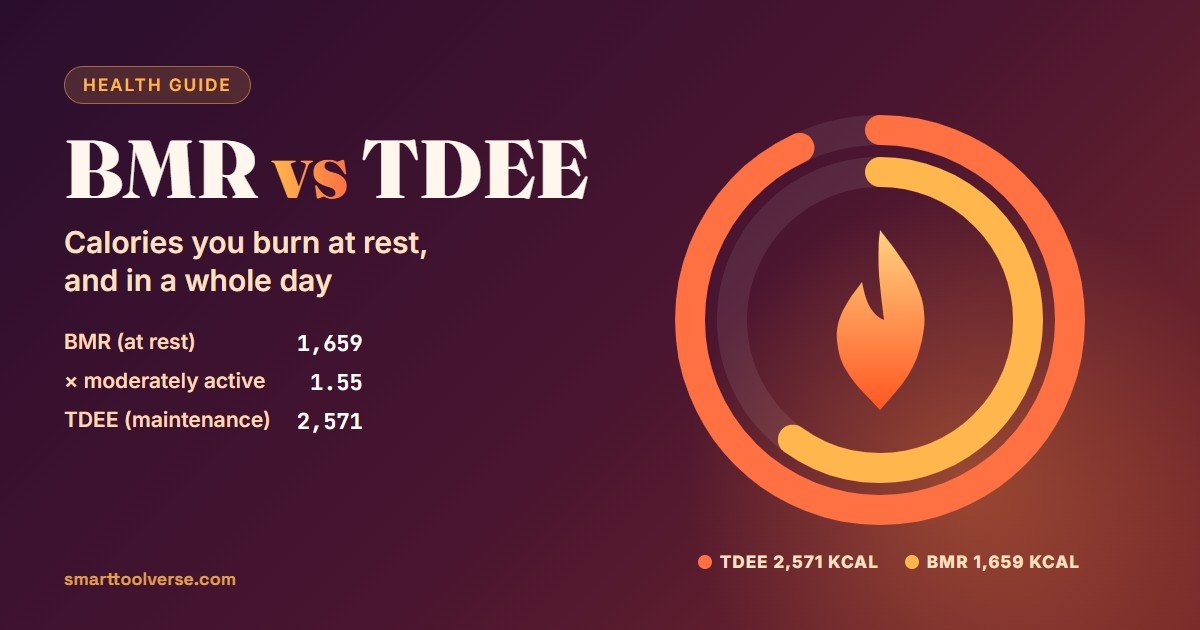
Short answer: BMR (basal metabolic rate) is the calories your body burns at complete rest, just to stay alive. TDEE (total daily energy expenditure) is BMR plus everything you do in a day, from walking to exercise. TDEE = BMR × an activity factor between 1.2 and 1.9. Our free BMR Calculator works out both and suggests calorie targets to lose, keep or gain weight.
BMR and TDEE at a glance
| BMR | TDEE | |
|---|---|---|
| What it measures | Calories burned at rest (breathing, heartbeat, organs) | Calories burned in a whole day, including activity |
| Share of daily burn | Usually the largest part, often 60 to 70% | 100% |
| Changes with | Weight, height, age, sex, muscle mass | All of those plus how active you are |
| Use it for | A floor: the energy your body needs to function | Your maintenance calories: eat this to keep your weight |
How to calculate BMR: the Mifflin-St Jeor formula
Mifflin-St Jeor (1990) is the formula most dietitians use today, because it predicts measured BMR better than older equations for most adults. Weight in kilograms, height in centimetres, age in years:
Men:    BMR = 10 × weight + 6.25 × height − 5 × age + 5
Women:  BMR = 10 × weight + 6.25 × height − 5 × age − 161
From pounds and inches: kilograms = pounds × 0.4536, centimetres = inches × 2.54.
Worked example 1: man, 28, 70 kg, 175 cm
- 10 × 70 = 700
- 6.25 × 175 = 1,093.75
- 5 × 28 = 140
- BMR = 700 + 1,093.75 − 140 + 5 = 1,659 kcal a day
Worked example 2: woman, 35, 60 kg, 165 cm
- 10 × 60 = 600
- 6.25 × 165 = 1,031.25
- 5 × 35 = 175
- BMR = 600 + 1,031.25 − 175 − 161 = 1,295 kcal a day
From BMR to TDEE: activity multipliers
Multiply your BMR by the factor that matches your normal week:
| Activity level | Multiplier | Example 1 (BMR 1,659) | Example 2 (BMR 1,295) |
|---|---|---|---|
| Sedentary: little or no exercise | 1.2 | 1,990 | 1,554 |
| Lightly active: light exercise 1-3 days a week | 1.375 | 2,281 | 1,781 |
| Moderately active: exercise 3-5 days a week | 1.55 | 2,571 | 2,008 |
| Very active: hard exercise 6-7 days a week | 1.725 | 2,861 | 2,234 |
| Extremely active: very hard physical job or training twice a day | 1.9 | 3,152 | 2,461 |
Most people overestimate how active they are. If you sit at a desk and work out three times a week, start with "lightly active" and adjust after a few weeks.
Turning TDEE into a calorie target
| Goal | Daily calories | Example 1 (moderately active) |
|---|---|---|
| Keep your weight | TDEE | 2,571 |
| Lose weight steadily | TDEE − 500 | 2,071 |
| Gain weight (muscle) | TDEE + 500 | 3,071 |
A daily gap of about 500 kcal is a common starting point and is often quoted as roughly 0.5 kg (1 lb) a week. That rule of thumb overstates long-term loss, because your TDEE falls as you get lighter, so recheck your numbers every few kilos.
Our BMR Calculator never suggests going below 1,500 kcal for men or 1,200 kcal for women, a common floor for diets without medical supervision. It also gives a protein, fat and carbohydrate split for each goal.
Mifflin-St Jeor or Harris-Benedict?
The Harris-Benedict equation (1919, revised in 1984) is the older formula. It usually gives a slightly higher number: for the man in example 1 it gives 1,707 kcal instead of 1,659.
Men:    BMR = 88.362 + 13.397 × weight + 4.799 × height − 5.677 × age
Women:  BMR = 447.593 + 9.247 × weight + 3.098 × height − 4.330 × age
Our calculator uses Mifflin-St Jeor by default and lets you switch to the revised Harris-Benedict formula. It shows the other formula's result too, so you can see the range.
What raises or lowers your BMR
- Muscle: muscle burns more energy at rest than fat, so two people with the same weight can have different BMRs.
- Age: BMR drops slowly with age, partly because people lose muscle.
- Body size: bigger and taller bodies burn more.
- Sex: men usually have a higher BMR at the same weight because of more muscle.
- Dieting: long, steep calorie cuts make the body burn a little less.
- Health: thyroid conditions, some medicines, pregnancy and illness all change it.
How accurate are these numbers?
Formulas estimate the average person with your measurements. Your real BMR can be 10% higher or lower. Use the result as a starting point, track your weight for 2 to 3 weeks, and adjust your intake by 100 to 200 kcal if your weight moves differently from what you expected.
These numbers are general information, not medical advice. If you are pregnant, under 18, have a medical condition or want to lose a lot of weight, talk to a doctor or a registered dietitian first.
FAQ
What is the difference between BMR and TDEE?
BMR is the energy you burn at rest. TDEE is the energy you burn in a full day, which adds walking, working, exercise and digesting food. TDEE is always higher than BMR.
Should I eat my BMR or my TDEE?
Base your calories on TDEE. Eating at your TDEE keeps your weight stable; eating a little below it makes you lose weight. Eating at or below your BMR for long periods is usually too low.
What is a normal BMR?
For most adults it is somewhere between about 1,200 and 2,000 kcal a day, depending on size, age, sex and muscle mass.
Does exercise increase BMR?
Exercise mainly raises TDEE. Strength training can raise BMR a little over time by adding muscle.
How do I calculate BMR in pounds and inches?
Convert first (pounds × 0.4536 = kg, inches × 2.54 = cm), or switch our BMR Calculator to imperial units and enter feet, inches and pounds directly.