AI content detectors promise to tell whether a piece of text was written by a person or by a chatbot such as ChatGPT, Claude or Gemini. They can be a useful signal, but they are often treated as a verdict, which they are not. This guide explains what detectors look at, why they get things wrong, and how to read a score. If you want to try one as you read, our free AI Content Detector shows its signals sentence by sentence.
What detectors measure
Language models write by repeatedly choosing a likely next word. That produces text with some measurable habits, and detectors look for them:
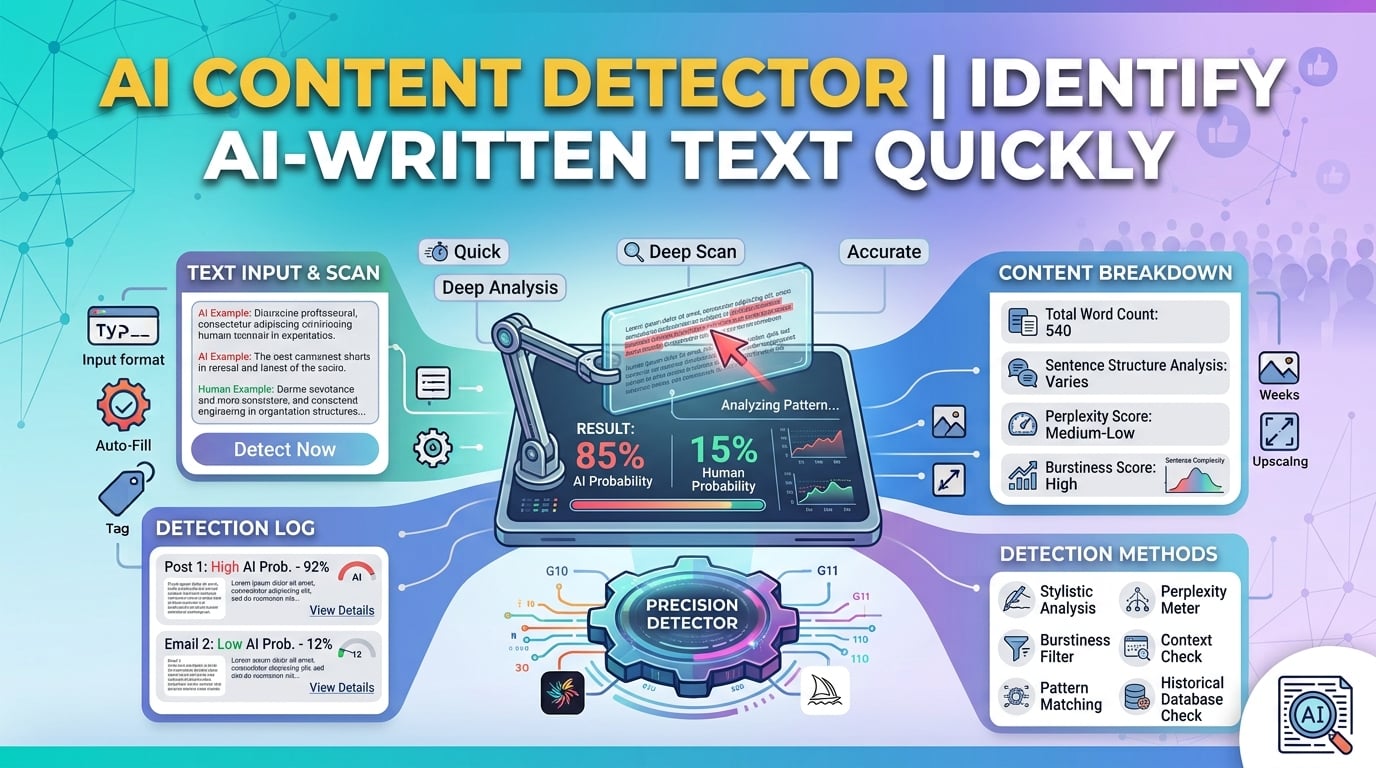
- Predictability. AI text tends to use the expected word more often than people do. Researchers call this low perplexity.
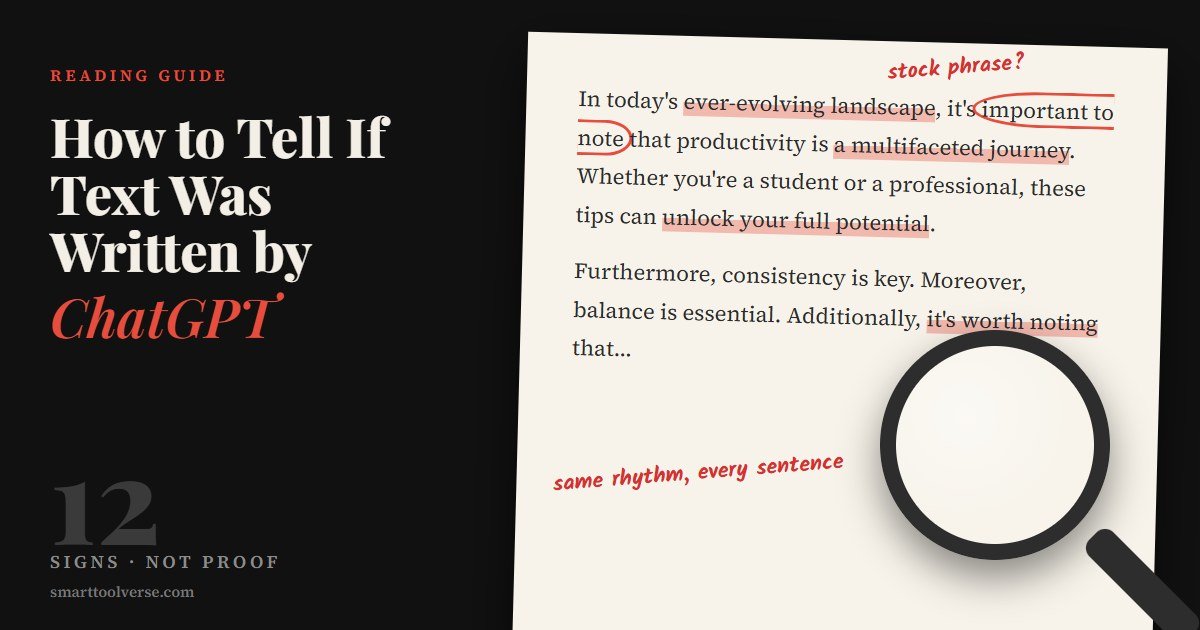
- Even rhythm. People mix short and long sentences; models often produce sentences of similar length. This variation is called burstiness.
- Vocabulary variety. Repeated words and a narrow range of vocabulary can point to generated text.
- Stock phrases. Openers and transitions such as "in today's fast-paced world" or "it is important to note" appear far more in chatbot output.
Some tools, including our AI Content Detector, also ask a language model for its own assessment and combine it with these measured signals. Either way, the output is a probability-style estimate, not a fingerprint.
Why detectors get it wrong
Every one of those signals also appears in human writing:
- Formal and technical writing is predictable by design: legal text, documentation and academic abstracts often score as "AI".
- Non-native English writers tend to use simpler, more common words, which lowers perplexity and raises the AI score.
- Edited AI text loses many of the signals. A few rewritten sentences can move a score from "AI" to "human".
- Short samples do not contain enough text to measure rhythm and variety reliably. Use at least 150–200 words.
Because of this, no detector can reliably name the specific model that wrote something, and none should be used as the only evidence in a decision about a person.
How to read a detection score
Our AI Content Detector reports a score from 0 to 100 and a band:
| Score | Band | How to treat it |
|---|---|---|
| 0–19 | Likely human-written | Few AI-typical signals. No action needed. |
| 20–39 | Mostly human signals | Normal for edited or formal human writing. |
| 40–59 | Mixed / uncertain | The signals disagree. Read the flagged sentences yourself. |
| 60–79 | Many AI-typical signals | Worth a closer look, alongside other evidence. |
| 80–100 | Strong AI-typical signals | Likely contains generated text, but still not proof. |
Look at which sentences are highlighted, not just the total. A score driven by one stock-phrase paragraph means something different from a score spread evenly across the text.
Using detectors responsibly
For teachers and editors
Treat a high score as a reason to talk, not a finding. Ask for drafts, notes or version history, and compare the text with the writer's earlier work. Writing style changes when people are tired, writing in a second language or following a strict template.
For writers
If your own writing is flagged, look at the highlighted sentences: they usually share long, evenly paced sentences and generic transitions. Varying sentence length, adding specific examples and cutting filler phrases make writing better for readers as well as less "AI-like". If you start from an AI draft, tools such as our AI Content Humanizer can help rewrite it, but adding your own knowledge and examples is what makes the text worth reading.
For publishers
Search engines judge whether content is helpful, not how it was produced. A detector score is a quality-control prompt: check whether the article adds first-hand experience, accurate facts and a clear answer.
Frequently asked questions
Can an AI detector prove that text was written by AI?
No. Detectors estimate how closely text matches patterns common in AI output. Human writing can match those patterns too, so a score is evidence to weigh, never proof on its own.
How much text does a detector need?
More text gives a steadier result. Our AI Content Detector needs at least 50 words and accepts up to 15,000 characters per check; 150–200 words or more is better.
Do detectors work on languages other than English?
The measured signals are weaker outside English, and most detectors are tuned on English text, so treat scores for other languages with extra caution.
Is my text stored when I use the AI Content Detector?
The writing statistics are calculated in your browser. When you click Analyze, the text is sent to our AI provider for the model assessment, and we don't store it.