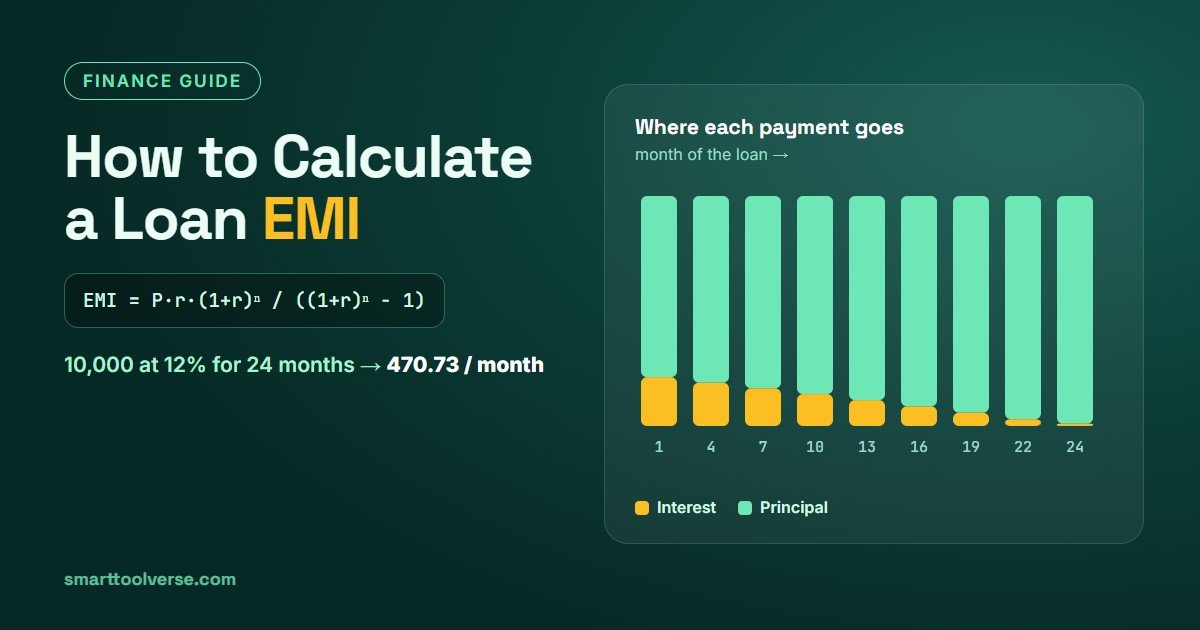
Short answer: EMI = P × r × (1 + r)n ÷ ((1 + r)n − 1), where P is the loan amount, r is the monthly interest rate (annual rate ÷ 12 ÷ 100) and n is the number of monthly payments. A 10,000 loan at 12% a year over 2 years costs 470.73 a month. Our free Loan Calculator works as a loan installment calculator: it does the maths, shows the full amortization schedule and works out what extra payments save.
What EMI means
EMI stands for equated monthly installment: the same payment every month until the loan is paid off. Each payment covers that month's interest first, and the rest reduces the balance. Mortgages, car loans and most personal loans work this way.
The EMI formula
EMI = P × r × (1 + r)^n / ((1 + r)^n − 1)

P = loan amount (principal)
r = monthly interest rate = annual rate ÷ 12 ÷ 100
n = number of monthly payments = years × 12
The most common mistake is using the yearly rate. 12% a year is 0.01 a month, not 0.12.
Worked example: 10,000 at 12% for 2 years
- P = 10,000
- r = 12 ÷ 12 ÷ 100 = 0.01
- n = 2 × 12 = 24
- (1 + r)n = 1.0124 = 1.269735
- EMI = 10,000 × 0.01 × 1.269735 ÷ (1.269735 − 1) = 126.9735 ÷ 0.269735 = 470.73
Over 24 months you pay 470.73 × 24 = 11,297.63, so the loan costs 1,297.63 in interest.
How each payment is split (amortization)
Interest is charged on the balance that is still owed, so early payments are mostly interest and later ones are mostly principal.
| Month | Payment | Interest (1% of balance) | Principal | Balance left |
|---|---|---|---|---|
| 1 | 470.73 | 100.00 | 370.73 | 9,629.27 |
| 2 | 470.73 | 96.29 | 374.44 | 9,254.83 |
| … | … | … | … | … |
| 24 | 470.73 | 4.66 | 466.07 | 0.00 |
The Loan Calculator shows this schedule for your loan, by year or by month, and you can export it as a CSV file for Excel or Google Sheets.
How the rate and term change the EMI
Monthly payment on a 10,000 loan:
| Annual rate | 1 year | 2 years | 3 years | 5 years |
|---|---|---|---|---|
| 6% | 860.66 | 443.21 | 304.22 | 193.33 |
| 9% | 874.51 | 456.85 | 318.00 | 207.58 |
| 12% | 888.49 | 470.73 | 332.14 | 222.44 |
| 15% | 902.58 | 484.87 | 346.65 | 237.90 |
A longer term lowers the payment but raises the total interest. The same 20,000 car loan at 8%:
| Term | Monthly payment | Total interest |
|---|---|---|
| 3 years | 626.73 | 2,562.18 |
| 5 years | 405.53 | 4,331.67 |
And a 200,000 mortgage at 7%: 1,550.60 a month over 20 years (172,143 interest) against 1,330.60 over 30 years (279,018 interest).
What an extra monthly payment saves
Every extra amount goes straight to the principal, so less interest is charged from then on. On a 350,000 mortgage at 6.5% over 30 years (EMI 2,212.24):
| No extra payment | +200 a month | |
|---|---|---|
| Paid off in | 360 months (30 years) | 286 months (about 23.8 years) |
| Total interest | 446,405.71 | 338,308.88 |
| Saved | 108,096.83 and 74 months |
Enter an amount in "Extra Prepayment / Month" in the Loan Calculator to see your interest saved, months saved and new payoff date. Check first whether your lender charges a prepayment fee.
Loan amount: how much can I borrow for a given payment?
Turn the formula around to find the loan amount a monthly budget allows:
Loan amount = EMI × ((1 + r)^n − 1) / (r × (1 + r)^n)With 600 a month for 3 years at 12% (r = 0.01, n = 36), you can borrow about 18,064.50. Check it by entering that amount in the Loan Calculator: the payment comes back as 600. In a spreadsheet, =PV(12%/12, 36, -600) gives the same amount.
The loan percentage: interest rate vs total interest
The interest rate is a yearly percentage, but what matters to your budget is the total interest as a percentage of the loan. In the 10,000 example at 12% over 2 years, total interest is 1,297.63, about 13% of the amount borrowed. Over 5 years at the same rate it is about 3,347, roughly 33%. A longer loan costs more even at the same rate.
Interest-free loans
At 0% the formula does not apply (it divides by zero). The payment is simply P ÷ n: 12,000 over 24 months is 500 a month.
EMI in Excel and Google Sheets
=PMT(12%/12, 24, -10000) → 470.73PMT takes the monthly rate, the number of payments and the loan amount (negative, because it is money you receive). =IPMT(...) and =PPMT(...) give the interest and principal part of a single payment.
Things the EMI does not include
- Processing or arrangement fees charged up front
- Insurance, property tax or escrow that some lenders add to a mortgage payment
- Rate changes on a variable-rate loan (the EMI is recalculated when the rate changes)
- Late payment charges
Compare loans by the total cost (all payments plus fees), not just by the monthly installment.
FAQ
What is the formula to calculate EMI?
EMI = P × r × (1 + r)^n ÷ ((1 + r)^n − 1), with P the loan amount, r the monthly rate (annual rate ÷ 1,200) and n the number of months.
How is interest calculated on a loan each month?
Monthly interest = balance still owed × annual rate ÷ 12. On a 10,000 balance at 12%, the first month's interest is 100.
Is it better to choose a shorter or longer loan term?
A shorter term costs more per month but much less in total. A longer term is easier on your monthly budget but you pay more interest overall.
Does paying extra reduce the EMI or the term?
With most loans the payment stays the same and the loan ends sooner, which is what our Loan Calculator models. Some lenders let you keep the term and lower the EMI instead; ask yours.
How do I calculate the loan amount from a monthly payment?
Use Loan amount = EMI × ((1 + r)^n − 1) ÷ (r × (1 + r)^n), or =PV(rate/12, months, -payment) in Excel. 600 a month for 36 months at 12% supports a loan of about 18,064.50.
Why is my bank's EMI slightly different?
Banks may round differently, charge interest daily, or add fees or insurance to the payment. The difference is usually a few cents to a few dollars.