Short answer: a percentage is a number out of 100, so X% of Y = (X ÷ 100) × Y. For example, 15% of 80 is 0.15 × 80 = 12. Almost every percentage question is one of the five formulas below. Our free Percentage Calculator has a tab for each one and shows the formula and steps with your numbers.
The five percentage formulas
| Question | Formula | Example |
|---|---|---|
| What is X% of Y? | (X ÷ 100) × Y | 15% of 80 = 12 |
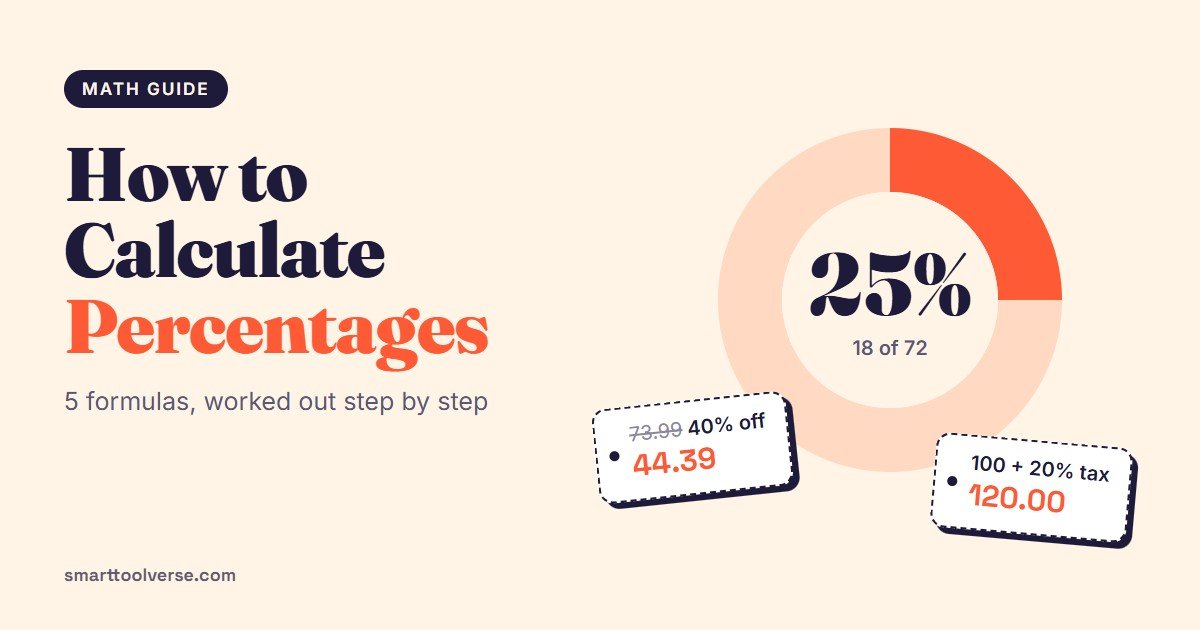
| X is what percent of Y? | (X ÷ Y) × 100 | 18 of 72 = 25% |
| Percentage change from old to new | (new − old) ÷ old × 100 | 50 → 65 = +30% |
| Increase or decrease Y by X% | Y × (1 ± X ÷ 100) | 200 + 15% = 230 |
| Original value before a % change | final ÷ (1 ± X ÷ 100) | 120 after +20% = 100 |
1. What is X% of Y?
Turn the percentage into a decimal by dividing it by 100, then multiply.
- 15% → 15 ÷ 100 = 0.15
- 0.15 × 80 = 12
Use it for tips, sales tax, commission or a share of a bill. A 20% tip on a 45 dollar meal is 0.20 × 45 = 9 dollars.
2. X is what percent of Y?
Divide the part by the whole, then multiply by 100.
- 18 ÷ 72 = 0.25
- 0.25 × 100 = 25%
Use it for test scores (42 out of 50 = 84%), progress (300 of 1,200 pages = 25%) or a share of a budget.
3. Percentage increase formula (and percentage decrease)
Subtract the old value from the new one, divide by the old value, and multiply by 100. A positive answer is an increase, a negative one is a decrease.
- A price goes from 50 to 65: 65 − 50 = 15
- 15 ÷ 50 = 0.30
- 0.30 × 100 = 30% increase
The other way: from 80 down to 60 is (60 − 80) ÷ 80 × 100 = −25%, a 25% decrease.
Always divide by the starting value. Going from 50 to 65 is a 30% rise, but going back from 65 to 50 is only a 23.1% fall, because the starting point is bigger.
4. Add or take off a percentage (percent off, tax and markups)
To increase a number by X%, multiply it by (1 + X ÷ 100). To decrease it, multiply by (1 − X ÷ 100).
- Add 15% to 200: 200 × 1.15 = 230
- Take 15% off 200: 200 × 0.85 = 170
- A 30% discount on a 59.99 item: 59.99 × 0.70 = 41.99 (for discounts with tax on top, use our Discount Calculator)
Percent-off examples people search for, worked out:
| Question | Working | Answer |
|---|---|---|
| 40% off 73.99 | 73.99 × 0.60 | 44.39 (you save 29.60) |
| 10% off 124.99 | 124.99 × 0.90 | 112.49 (you save 12.50) |
| 25% off 80, then 8% sales tax | 80 × 0.75 × 1.08 | 64.80 |
With tax and a discount, the order does not change the result: taking 25% off and then adding 8% tax gives the same total as adding the tax first. Two discounts in a row, though, are not the same as adding them: 20% off and then another 10% off is 28% off, not 30%.
5. Reverse percentage: find the original price before tax or a discount
If you know the price after a percentage was added or taken off, divide by the same multiplier. Do not just take the percentage off the final number: that gives the wrong answer.
- A price is 120 including 20% tax. Original: 120 ÷ 1.20 = 100 (not 120 − 20% = 96)
- A jacket costs 60 after a 25% discount. Original: 60 ÷ 0.75 = 80
This is the Reverse Percentage tab in our Percentage Calculator. It also refuses a 100% decrease, because anything reduced by 100% is 0 and the original can't be worked out.
Common percentage mistakes
| Mistake | Why it is wrong | Correct |
|---|---|---|
| +50% then −50% gets you back to the start | The second change applies to a bigger number | 100 → 150 → 75, a 25% loss overall |
| A rate going from 4% to 5% is a 1% rise | That is 1 percentage point, but a 25% increase in the rate | Say "1 percentage point" or "25% higher" |
| Removing tax by subtracting the tax rate | The tax was a percentage of the smaller, original price | Divide by (1 + rate) |
| Adding percentages from different totals | 10% of 200 and 10% of 50 are not "20%" of anything | Add the amounts, then divide by the combined total |
How to find the discount rate
If you know the original and the sale price, the discount rate is the percentage decrease: (original − sale) ÷ original × 100. A 60 item sold for 45 is (60 − 45) ÷ 60 × 100 = 25% off.
Percentage difference between two numbers
When neither number is the "old" one, for example comparing two prices from two shops, use the percentage difference: the gap divided by the average of the two, times 100.
- Prices 40 and 60: gap = 20, average = 50
- 20 ÷ 50 × 100 = 40% difference
Quick mental-math tricks
- 10%: move the decimal point one place left. 10% of 340 = 34.
- 5%: half of 10%. 5% of 340 = 17.
- 15%: 10% plus 5%. 15% of 340 = 34 + 17 = 51.
- 1%: move the decimal two places. 1% of 340 = 3.4, so 3% = 10.2.
- Swap them: X% of Y is the same as Y% of X. 8% of 50 is hard, 50% of 8 is 4.
Percentages in Excel and Google Sheets
| To work out | Formula (A1 and B1 hold the numbers) |
|---|---|
| X% of Y | =A1*B1 with A1 formatted as a percentage, or =A1/100*B1 |
| A1 as a percent of B1 | =A1/B1, then format the cell as a percentage |
| Change from A1 to B1 | =(B1-A1)/A1, formatted as a percentage |
| Add 15% to A1 | =A1*(1+15%) |
| Original before +20% | =A1/(1+20%) |
FAQ
What is the formula for percentage?
Percentage = (part ÷ whole) × 100. To find a percentage of a number, reverse it: part = (percentage ÷ 100) × whole.
How do I calculate a percentage increase?
Subtract the old value from the new value, divide by the old value and multiply by 100. From 50 to 65 is (65 − 50) ÷ 50 × 100 = 30%. The Percentage Change tab in our Percentage Calculator does this and shows the steps.
How do I take a percentage off a price?
Multiply the price by (1 − percentage ÷ 100). 25% off 80 is 80 × 0.75 = 60, and 40% off 73.99 is 73.99 × 0.60 = 44.39.
How do I work out the tax percentage I paid?
Divide the tax amount by the price before tax and multiply by 100. Paying 6.30 tax on a 90 purchase is 6.30 ÷ 90 × 100 = 7%.
How do I find the original price before a discount?
Divide the sale price by (1 − discount ÷ 100). A 60 price after 25% off was 60 ÷ 0.75 = 80 before the discount.
Is a percentage point the same as a percent?
No. A percentage point is the plain difference between two percentages (4% to 5% is 1 point). A percent change is relative to the starting value (4% to 5% is a 25% increase).