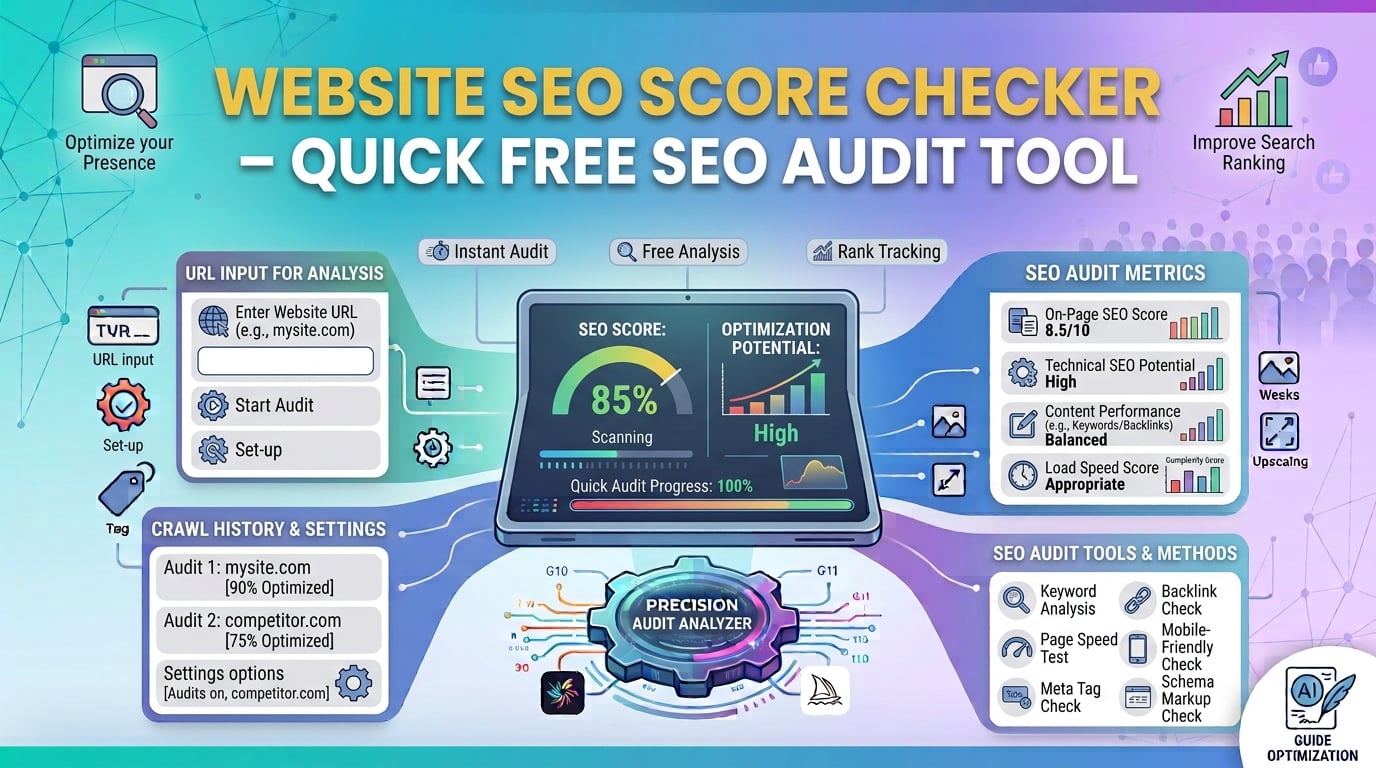
Short answer: on a 0–100 scale, a good SEO score is 80 or higher (grade B), and 90+ (grade A) is excellent. Below 65 the page has real gaps in its basics. To get your own number, check your SEO score with our free audit, which grades any public page in a few seconds.
The number is only useful if you know what sits behind it, so this guide explains the grades, what the score measures and what it ignores, and which fixes raise it fastest.
SEO score grades, from A to F
Our checker turns the score into a letter grade with these bands:
| Score | Grade | What it usually means |
|---|---|---|
| 90–100 | A (Excellent) | The basics are done. Further gains come from content quality and links, not markup. |
| 80–89 | B (Good) | Solid page with a few gaps, often social tags, sources or schema details. |
| 65–79 | C (Needs work) | Several missing pieces, such as no meta description, weak headings or no share image. |
| 50–64 | D (Poor) | Important elements are missing in more than one area. |
| Below 50 | F (Critical issues) | Something basic is broken: no title, blocked from indexing, no HTTPS or an empty page. |
Other tools use other bands, so a "B" elsewhere is not the same as a B here. The rest of this guide uses the bands above.
What your SEO score measures, and what it can't
An SEO score is a checklist turned into a number. The audit fetches one page from our server and runs more than 55 checks on it, from HTTPS and the canonical tag to headings, keyword placement, author bylines and structured data. Each check gets one of three results:
- PASS: full points.
- IMPROVE (needs improvement): half points. Example: a title of 65 characters, inside the 15–70 range the check tolerates but outside the 30–60 target.
- FIX (fail): zero points. Example: no meta description at all.
Checks are also weighted from 1 to 3 inside their section. HTTPS, indexability, the title tag and main keyword placement count 3; a favicon or the HTML lang attribute count 1. Checks marked INFO are shown but not scored.
What the score cannot see:
- Rankings. It doesn't know where you rank or how much traffic you get. That lives in Google Search Console.
- Backlinks and authority. Links from other sites matter a lot for ranking and are invisible to a single-page audit.
- Search intent. A page can pass every check and still not answer what people searching for its keyword want.
- Content quality. It can count words, sources and readability, but it can't tell whether the advice is right.
Google says this plainly in its SEO Starter Guide: there are "no secrets here that'll automatically rank your site first in Google." A high score means the page is easy to crawl, understand and share. It doesn't mean it will rank.
How the sections are weighted
Each section gets its own 0–100 score (the weighted share of points it earned). The overall score is then a weighted average of the seven sections:
| Section | Share of the score | Examples of checks |
|---|---|---|
| On-page & keywords | 25% | Title, meta description, H1, keyword placement, content depth, alt text, internal links, broken links |
| Technical | 20% | HTTPS, indexable, canonical, robots.txt, sitemap, mobile viewport, server response time, render-blocking scripts |
| GEO (AI search) | 13% | AI search crawlers allowed, content readable without JavaScript, cited sources, facts and figures, freshness date |
| AEO (answer engines) | 12% | Question-style headings, direct answers under them, answer-first intro, lists and tables |
| E-E-A-T (trust) | 12% | Author byline and profile, About/Contact/Privacy pages, publication date, references |
| Structured data | 10% | JSON-LD present and valid, required and recommended properties, breadcrumbs |
| Social sharing | 8% | Open Graph title and description, share image, X card |
Two numbers sit outside this table. Speed and Core Web Vitals come from Google PageSpeed Insights and are shown in their own tab, not mixed into the score. The AI search readiness score reuses four sections with different weights: GEO 40%, AEO 25%, E-E-A-T 20% and structured data 15%. If that one is low, our AI Crawler Checker shows which AI bots your robots.txt lets in across the whole site.
Why do different tools give different SEO scores?
Run the same page through three tools and you can get 72, 85 and 91. None of them is wrong; they measure different things:
- Different check lists. Some tools test 15 things, some test 100. Ours includes AI-search and trust checks that many older tools don't have.
- Different weights. Lighthouse weights each SEO audit equally, apart from a manual structured data audit (Chrome docs). We weight checks 1–3 and then weight the sections, so a missing title costs far more than a missing favicon.
- Different thresholds. One tool passes a 70-character title, another flags anything over 60.
- Partial credit or not. Some tools are pass/fail only. Ours gives half points for "needs improvement".
- What gets fetched. Some tools render JavaScript, some read the raw HTML, some crawl the whole site and average the pages.
Pick one tool and compare a page against its own earlier score. A trend in one tool tells you more than a single number from three.
How to improve your SEO score: fix in order of impact
Not every failed check is worth the same. A rough way to estimate what a fix adds to the overall score:
points ≈ section share × (check weight ÷ total check weight in that section) × gain
The gain is 1 for FIX to PASS and 0.5 for IMPROVE to PASS. Two things follow from it:
- Fails before improvements. Turning a FIX into a PASS earns twice what an IMPROVE does for the same check.
- Small sections move fast. Social sharing is only 8% of the score, but it has just three checks, so adding a missing share image (weight 2 of 5) is worth about 3 points. A missing meta description (weight 2 of about 24 in on-page) is worth about 2.
You don't have to do the arithmetic. When you run the free SEO score checker, its "Top fixes" tab lists every FIX before any IMPROVE, puts heavier checks first within each group and nudges technical and GEO issues up. Work down that list, then re-run the audit.
One exception: if the page is blocked from indexing (noindex), redirects badly or isn't on HTTPS, fix that first whatever the score says. Nothing else matters until search engines can reach the page.
Example: moving a page from C to B
Take a gardening blog post, "How to repot a snake plant", that scores 75 (C). Its section scores: Technical 90, On-page 71, AEO 50, GEO 68, E-E-A-T 82, Structured data 95, Social 60. The FIX items in its report are: no meta description, no share image, no question-style headings, and no links to outside sources.
| Step | Change | Section change | Overall |
|---|---|---|---|
| Start | 75 (C) | ||
| 1 | Write a 140-character meta description | On-page 71 → 79 | 77 (C) |
| 2 | Add a 1200×630 og:image | Social 60 → 100 | 80 (B) |
| 3 | Rename three H2s as questions ("How often should you repot a snake plant?") and open each with a short direct answer | AEO 50 → 85 | 84 (B) |
Three edits, and the page goes from C to a solid B. Step 3 also lifts the AI search readiness score from 70 to 79. Adding two cited sources would push it further, because that clears a FIX in both GEO and E-E-A-T.
Notice what was not touched: the content itself was already fine. If it hadn't been, the score would still have reached 84, which is why the number is a floor for the basics, not a measure of quality. While you're on the technical side, the Mobile Friendly Test checks more mobile-friendliness signals than the single viewport check in this audit.
FAQ
Do I need an SEO score of 100?
No. Going from 60 to 85 usually fixes real problems that affect how the page is crawled and shown. Going from 92 to 100 rarely changes anything, because some checks (an llms.txt file, breadcrumb schema, an author profile link) don't apply equally to every page. Aim for 80+ on your important pages and stop there.
Does a high SEO score guarantee rankings?
No. The score checks on-page signals. Rankings also depend on relevance, backlinks and competition. Google says even good Core Web Vitals "doesn't guarantee that your pages will rank at the top" (Google Search Central), and the same is true of any audit score.
What does my SEO score mean if it changed without any edits?
Some checks depend on things outside the page: server response time, a link in the checked sample that has since broken, a robots.txt change, or a freshness date getting older than a year. Re-run the audit and compare the section scores to see which one moved.
How often should I check my SEO score?
Before publishing an important page, after any template or theme change, and when a page loses traffic. Most on-page problems come from site changes, not from time passing, so a monthly check of your top pages is plenty.
Ready to see your own number? Check your page's SEO score for free, open the "Top fixes" tab and start with the first FIX on the list.